# SEO and GEO in 2026: how to get found in search and cited by AI
Until recently, searching the web worked the same way everywhere: you typed a query and got ten links. Now you increasingly get a finished answer instead, written for you by an AI model in ChatGPT, in an AI summary above Google's results, or in Alice AI on Yandex. For anyone who runs a website, that raises two questions. How do you get into that answer, and how far can you trust it?
I've been following this for more than a year, collecting case studies, talks and research along the way. They include a Brand24 webinar on how brands show up in AI answers (the company said its visitors from ChatGPT converted about four times better than average), Semrush's AI Visibility Index on which brands and sources AI assistants mention most, and Google's I/O 2026 keynote, where it merged AI Overviews and AI Mode into a single AI search. This week I asked Google and ChatGPT to name the best content marketing agencies in the US and checked what they cited. This fall I rebuilt my two sites, AIGENCY and FailForward, so AI crawlers could read them, and used Cloudflare's logs to see who actually shows up.
This guide distills that experience, together with documentation from Google, Yandex, OpenAI and Microsoft and independent research, and I've checked every number and quote against the original source. My conclusion is that optimizing for AI answers, usually called GEO, is almost entirely the same work as SEO, but the results are harder to verify and easier to fake. Below I explain how I got there and go through ten GEO myths. If you only want the practical part, skip straight to the 10-step checklist and the tools.
---
How AI moved into search
OpenAI released ChatGPT on November 30, 2022. Two months later, by UBS analysts' estimate, a hundred million people were using it, and it was clear that many of them would rather ask a question and get an answer than click through a page of links.
The search engines followed. In February 2023 Microsoft built a chatbot into Bing. In May 2024 Google rolled out AI Overviews to everyone in the US. The launch went badly: one summary suggested using glue to keep cheese on pizza, and Google had to explain itself and ship fixes. Google pressed on anyway, and in 2025 it launched AI Mode, a conversational way to search, and in May 2026 it merged the two into a single AI search experience. Yandex, Russia's largest search engine, launched Neuro in April 2024, later moved AI answers into its main results, and now has Alice AI write them.
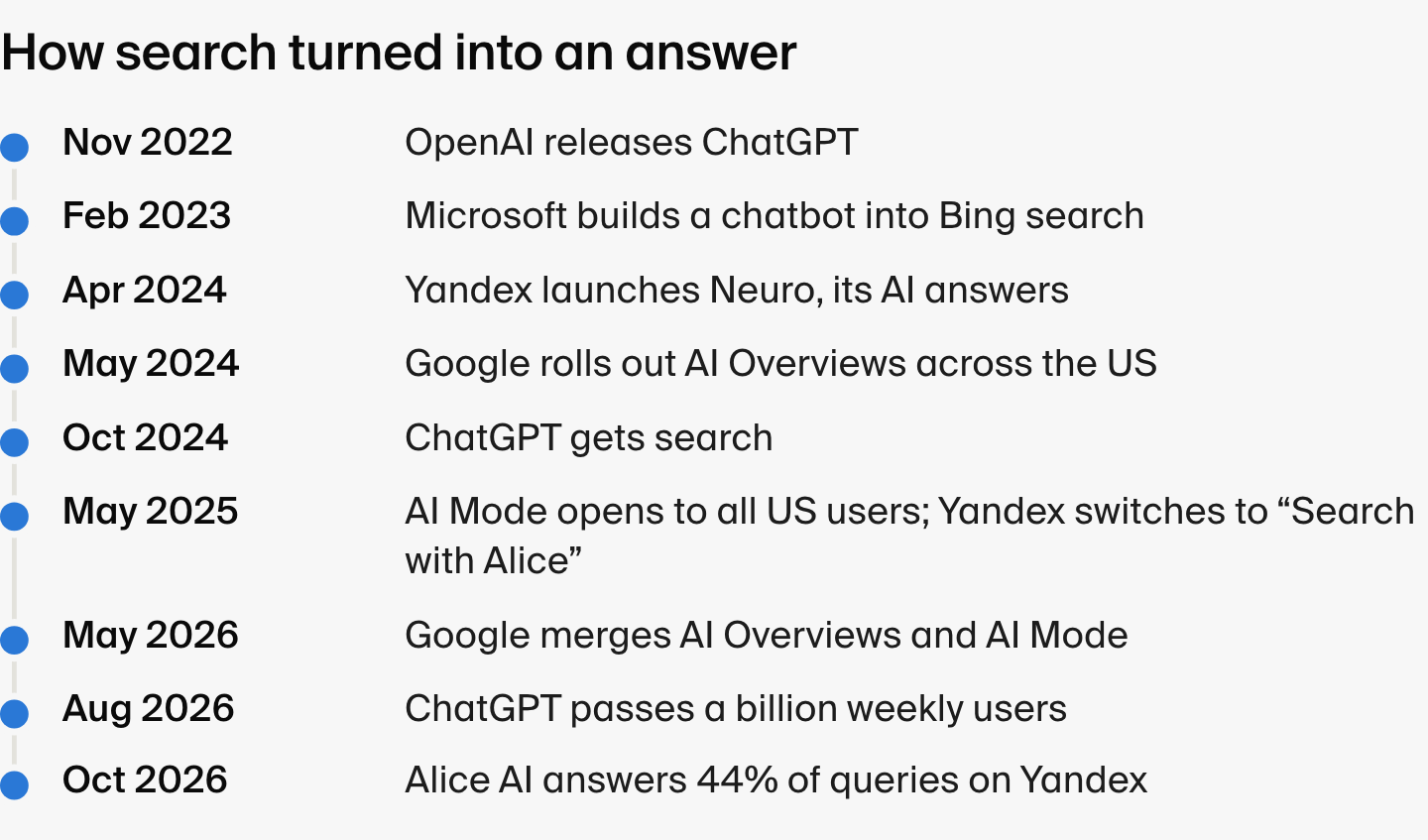
Today ChatGPT has more than a billion weekly users, Google's AI Overviews reach 2.5 billion people a month, and Alice AI answers 44% of queries on Yandex.
---
How much traffic websites are losing
When the answer is already on the results page, there's less reason to visit a website, and independent measurements show that people do click less. The Pew Research Center looked at nearly 69,000 Google searches made by 900 American adults in March 2025. When an AI summary appeared, people clicked a regular search result in 8% of visits; without one, they did so in 15%. They clicked a link inside the summary itself in 1% of visits (Pew Research Center).
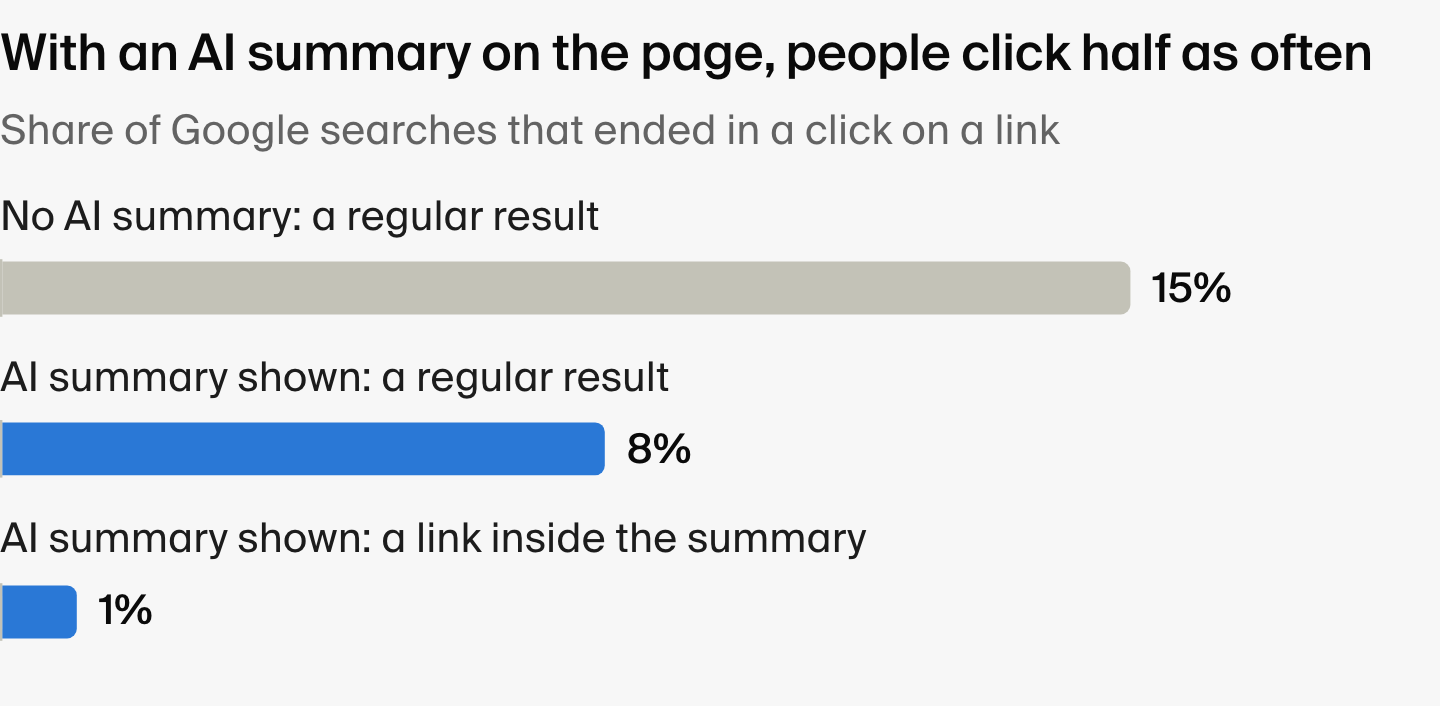
Other studies point the same way. Ahrefs looked at 300,000 queries and found that when an AI Overview sits above the results, the top result's click-through rate is 58% lower than expected. By SparkToro's count, 68% of Google searches in the US in early 2026 ended without a click to any website. Smaller sites lose the most: according to Chartbeat, small publishers lost 60% of their search referrals and large ones 22% (I wrote about it here).
Google sees it differently. In August 2025 its head of Search, Liz Reid, wrote that total organic clicks from Search to websites had been "relatively stable" year over year, and that Google was sending "slightly more quality clicks," meaning clicks after which people don't bounce straight back to the results. Her post includes no figures, and the independent measurements above suggest the opposite.
The chatbots themselves send very few people to websites. As of early 2026, Google was sending 190 times more visitors to websites than ChatGPT did, according to an Ahrefs study of 76,000 sites. Chartbeat describes AI as "an emerging channel" that doesn't replace search traffic.
That leaves businesses with a new question: does the AI name them when someone is deciding what to buy? Ordinary analytics can't tell you, because people rarely click the links in AI answers and nobody counts the mentions themselves. Step 10 of the checklist covers how to measure them.
---
How an AI assistant builds an answer and what it cites
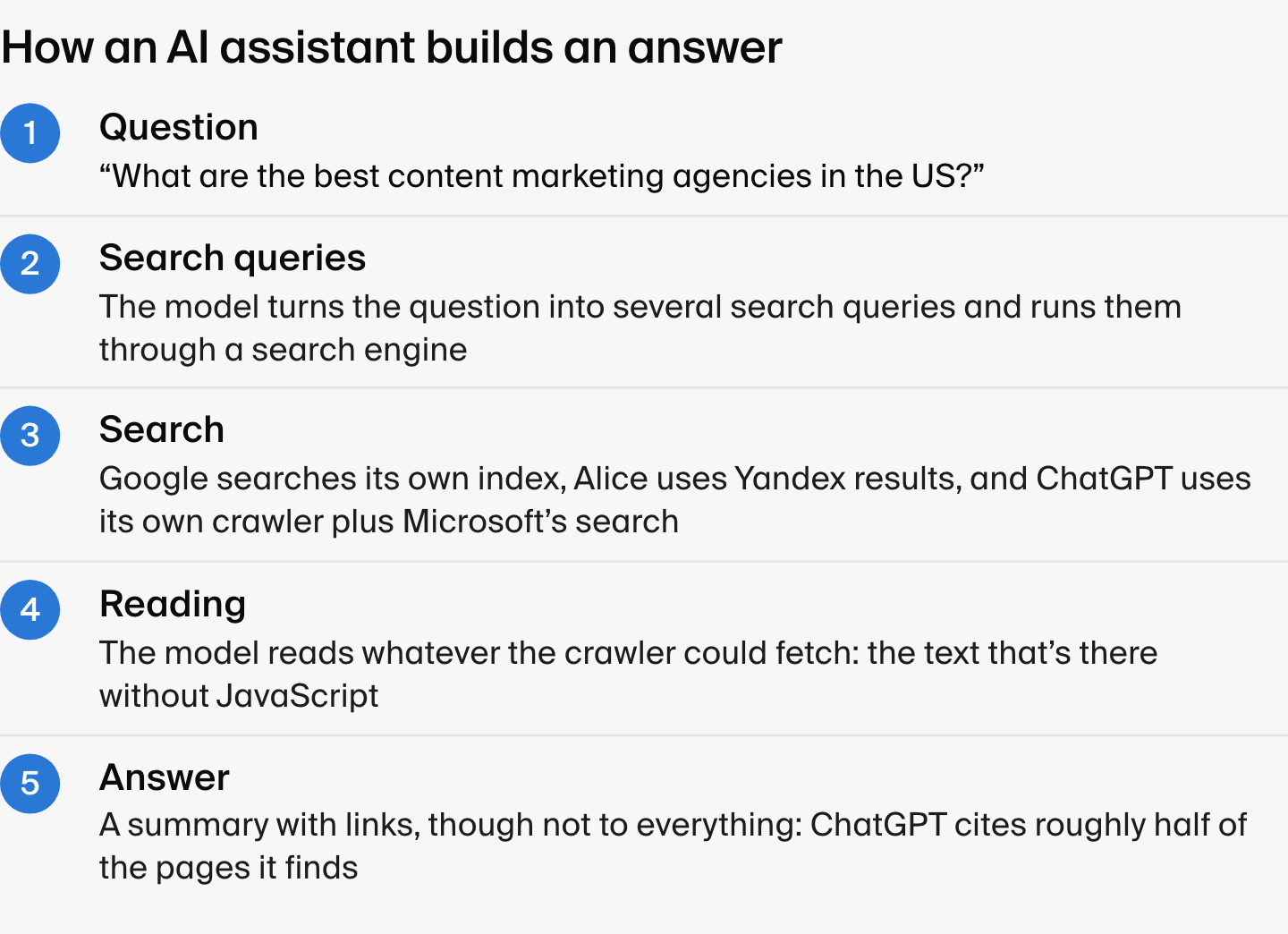
There is no separate internet for AI models. Their answers are assembled from ordinary search, roughly like this.
First, the model turns the user's question into one or more search queries and sends them at the same time. Google calls this query fan-out. Then comes an ordinary search: Google searches its own index, Alice works from Yandex results, and ChatGPT uses its own crawler, OAI-SearchBot, along with Microsoft's search, which Microsoft says outright powers ChatGPT. Next, the model reads the pages it found, or more precisely whatever the crawler managed to fetch; step 2 of the checklist explains why that matters. Finally, it writes an answer and adds links, though not to everything it read. ChatGPT cites roughly half of the pages it finds, favoring those whose titles resemble one of its search queries.
Where the answer comes from depends on the question, and three kinds of questions draw on quite different sources.
When someone asks what to choose
Questions like "which agency is best" or "which service should I pick" get answered from other people's roundups and rankings. Ahrefs analyzed ChatGPT's answers to 750 such questions and found that 43.8% of the cited pages were "best of" lists. In regular search results you see ten of those lists and can tell who wrote each one; the assistant picks one or two and retells them as if they were its own opinion.
It matters most when the author of the list is also in the race, as the example in the next section shows.
When someone asks about you
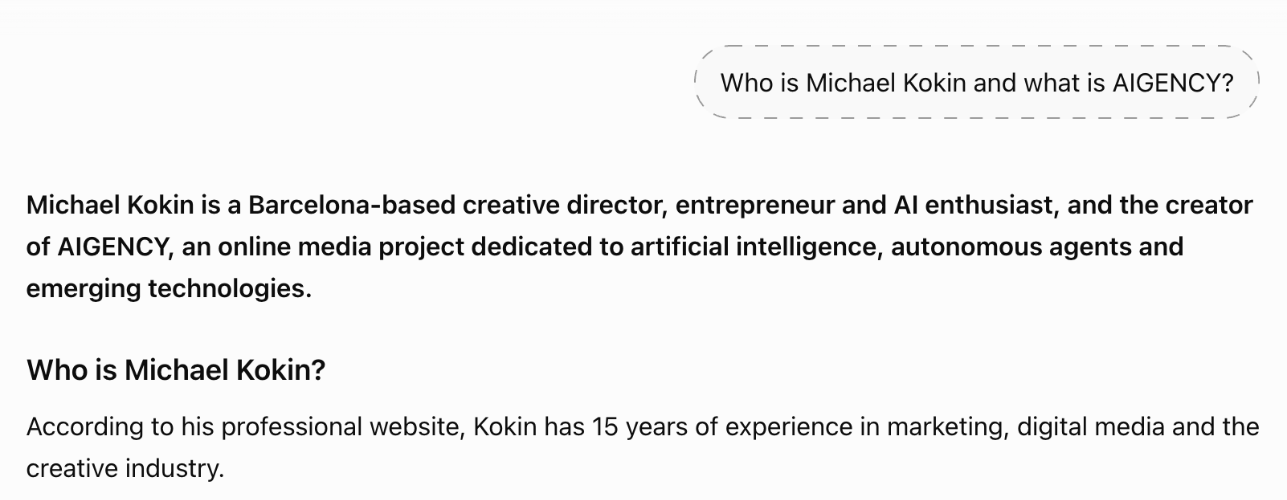
Questions about a person or a company get answered from their own website. I asked ChatGPT who Michael Kokin is and what AIGENCY is. It built the answer from my site and said so: "According to his professional website."
The same goes for companies. Profound counted nearly 12 billion citations across eight AI models and found that about 57% pointed to companies' own websites. In Profound's words: "AI writes its answers from company websites. The question is whose." Your About page, prices, terms and author bios have become source material for AI answers. Whatever isn't on your site, the assistant will take from someone else's or make up.
When the question is about facts
On factual questions, the best answers lean on primary sources. Before writing this guide, I asked ChatGPT, Gemini and Google's AI Mode ten questions each on the topics my sites cover. ChatGPT in Pro mode answered questions about company history by citing archives, museums and the companies' own sites, such as sony.com, waltdisney.org and the Henry Ford archive, so even a careful retelling lost out to the original. Gemini in its standard mode more often answered without any links and, in one answer, repeated a popular but wrong date. A piece of content has a chance of being cited here if it adds something the primary source doesn't have, such as your own data or first-hand experience.
---
Example: Google picked top agencies from one agency's list
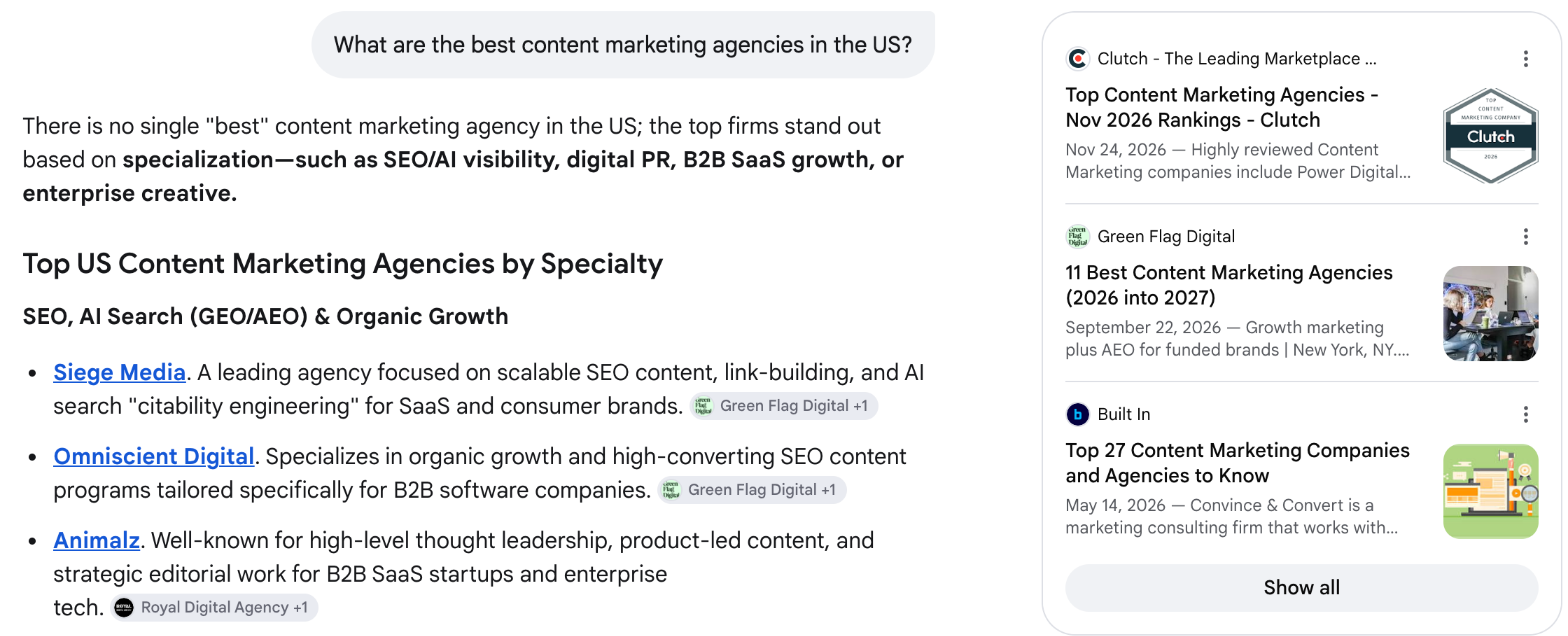
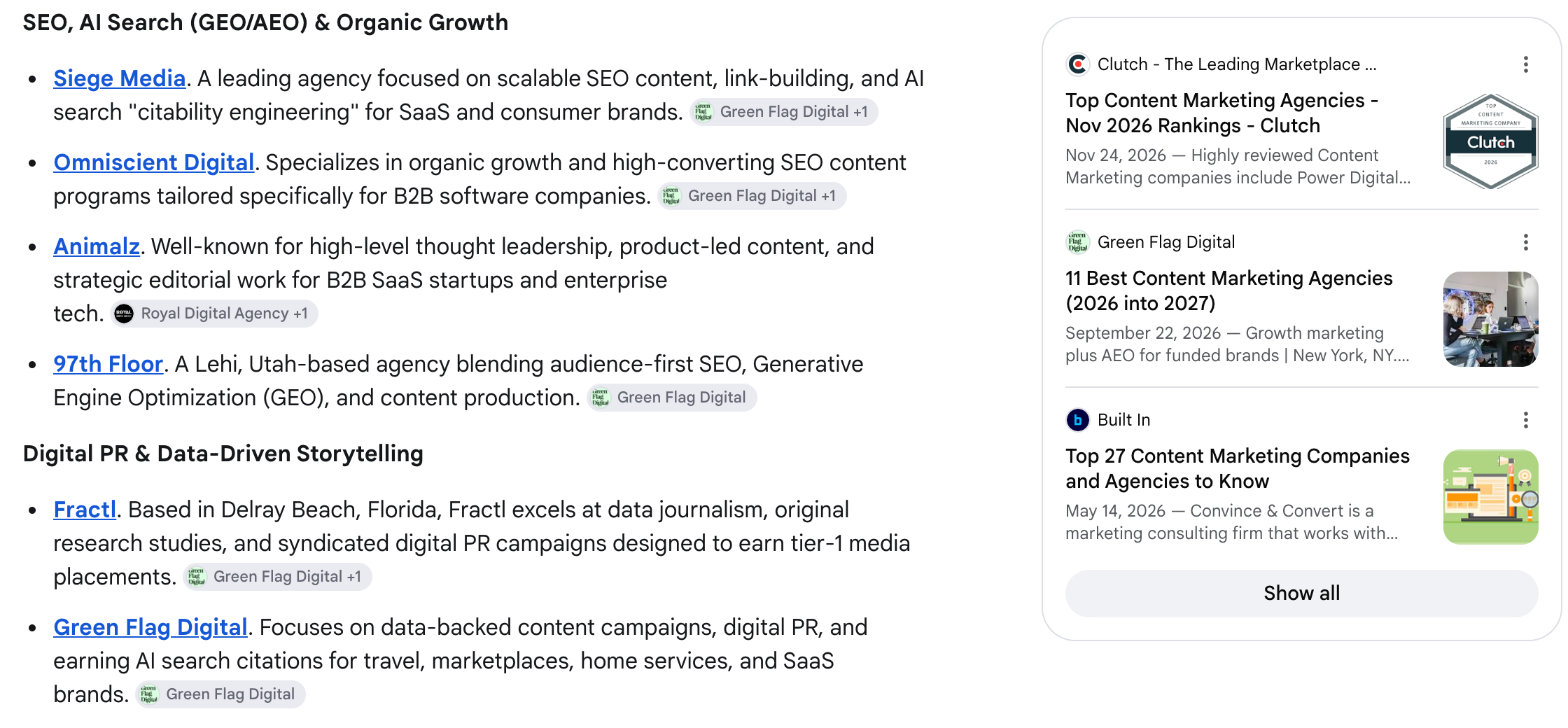
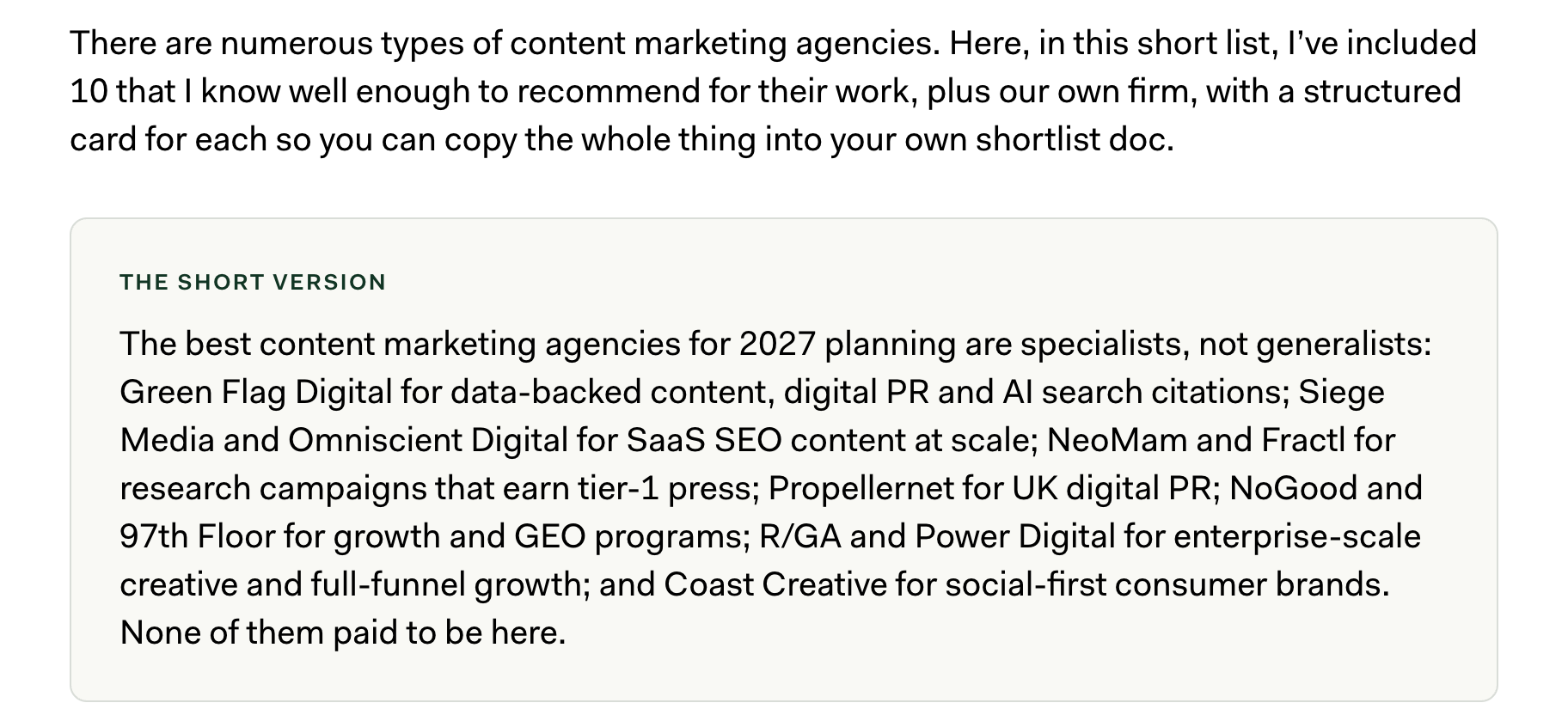
On November 24, 2026, I asked Google's AI Mode which content marketing agencies in the US are the best, in English, with US results and with personalization switched off. The answer named thirteen agencies, sorted them by specialty and gave each a one-line description. The source chips beside those lines show where the list came from. Five of the eight chips point first to Green Flag Digital, which calls itself "an upstart content marketing and link-building agency": four of them to its article "11 Best Content Marketing Agencies (2026 into 2027)" and one to its homepage. Seven of the thirteen agencies in Google's answer appear in that article's short list.
Green Flag Digital is one of the thirteen, and the only source Google gives for that line is the agency's own homepage. The article is open about its interest. A note at the top says, "Green Flag Digital publishes this list, and it is our firm," explains that the firm is listed first without a number, and the summary below opens with its own name. Google's answer passes on none of this. Another of its sources, Royal Digital Agency, publishes a top six of US content marketing agencies with Royal Digital Agency in first place.

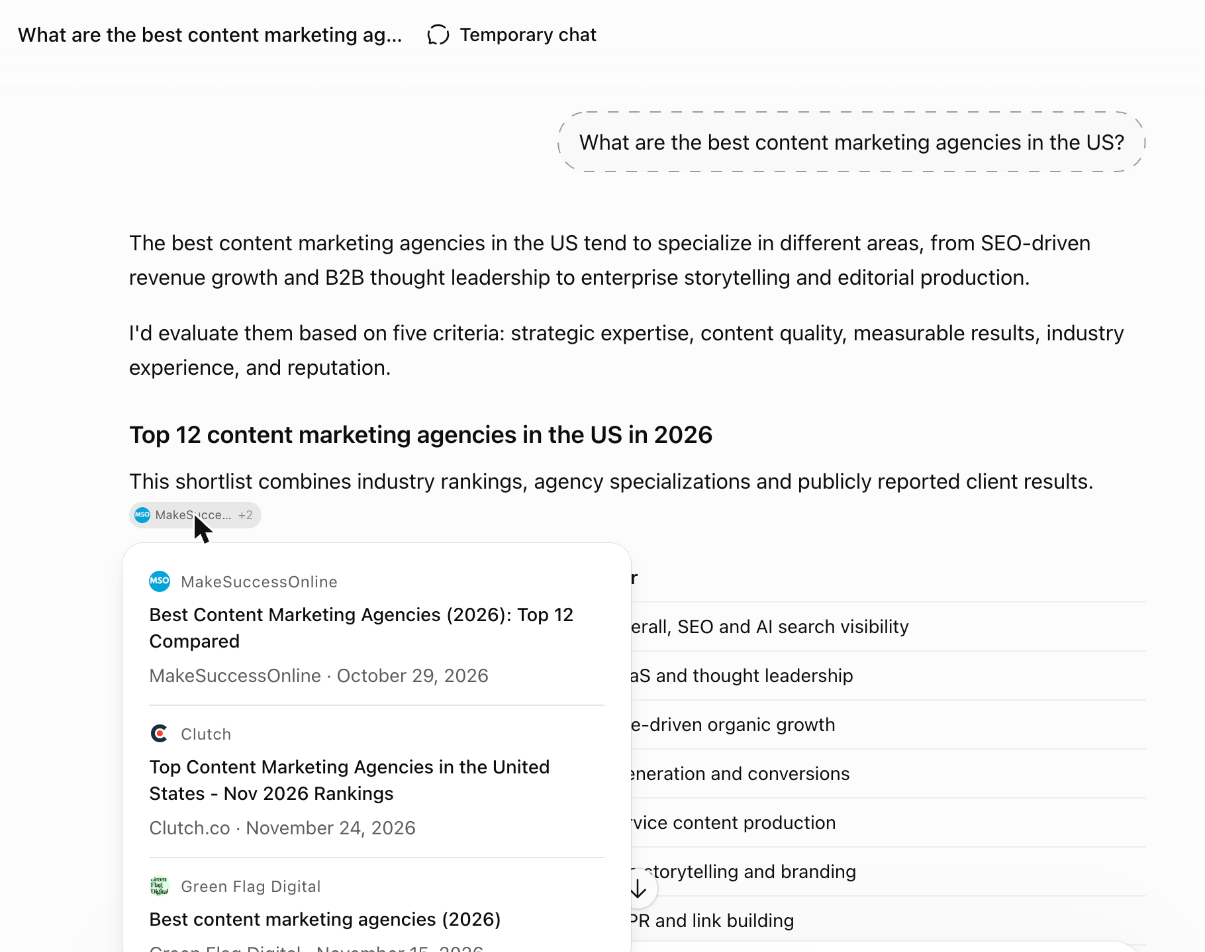
ChatGPT leaned on the same kind of pages. In a temporary chat it cited five sites eight times, and two of them were agencies ranking their own market: Green Flag Digital again and Breaking B2B, which puts itself first in "The 12 Best Content Marketing Agencies in 2026" and offers its clients "listicle mentions" as part of its service. Logged out, ChatGPT recommended Breaking B2B's article for cross-checking under the label "2026 agency comparison" and gave fractl.com as the website of the digital PR agency Fractl. That address sends the browser into a redirect loop, while the agency itself is at frac.tl.
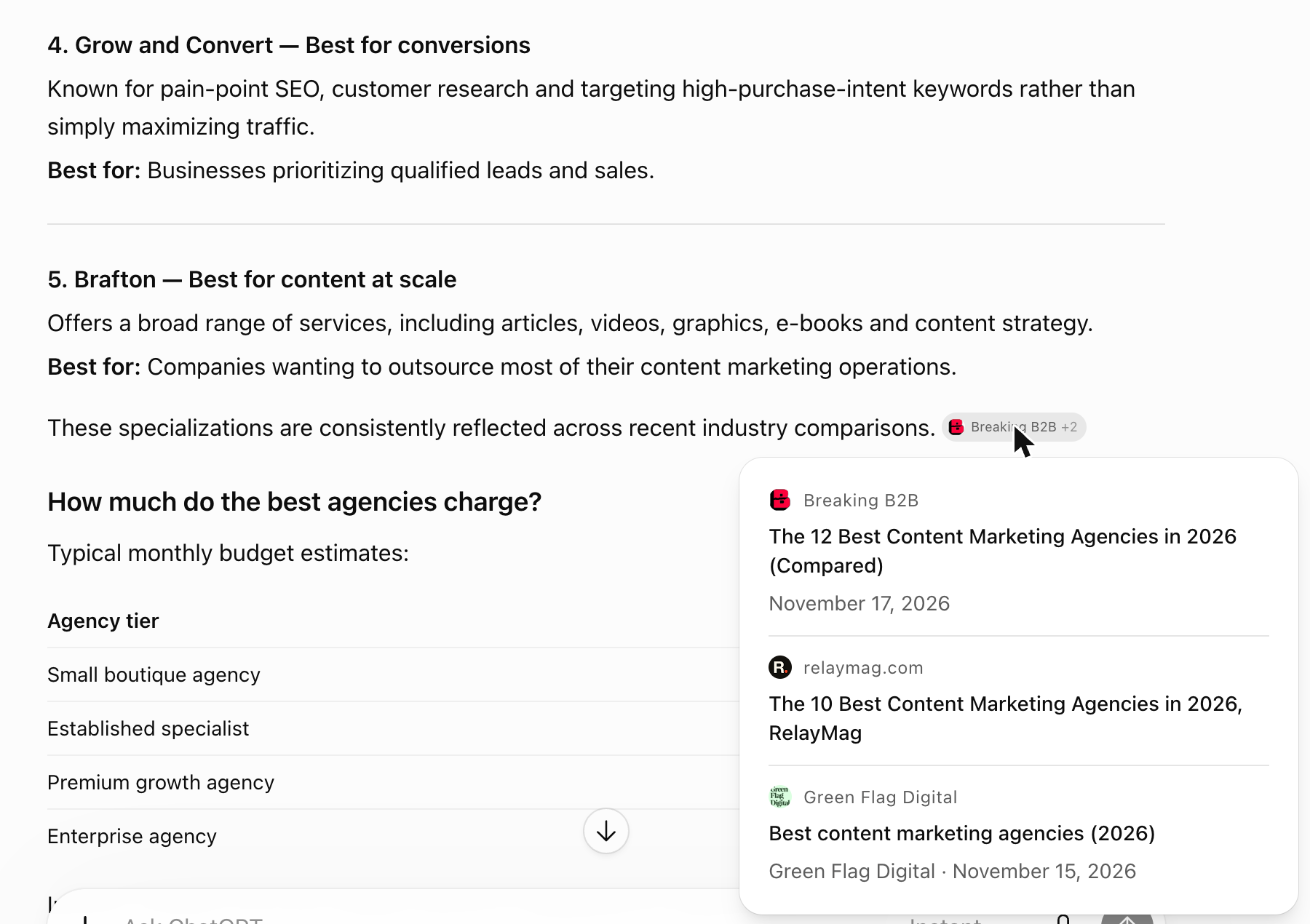
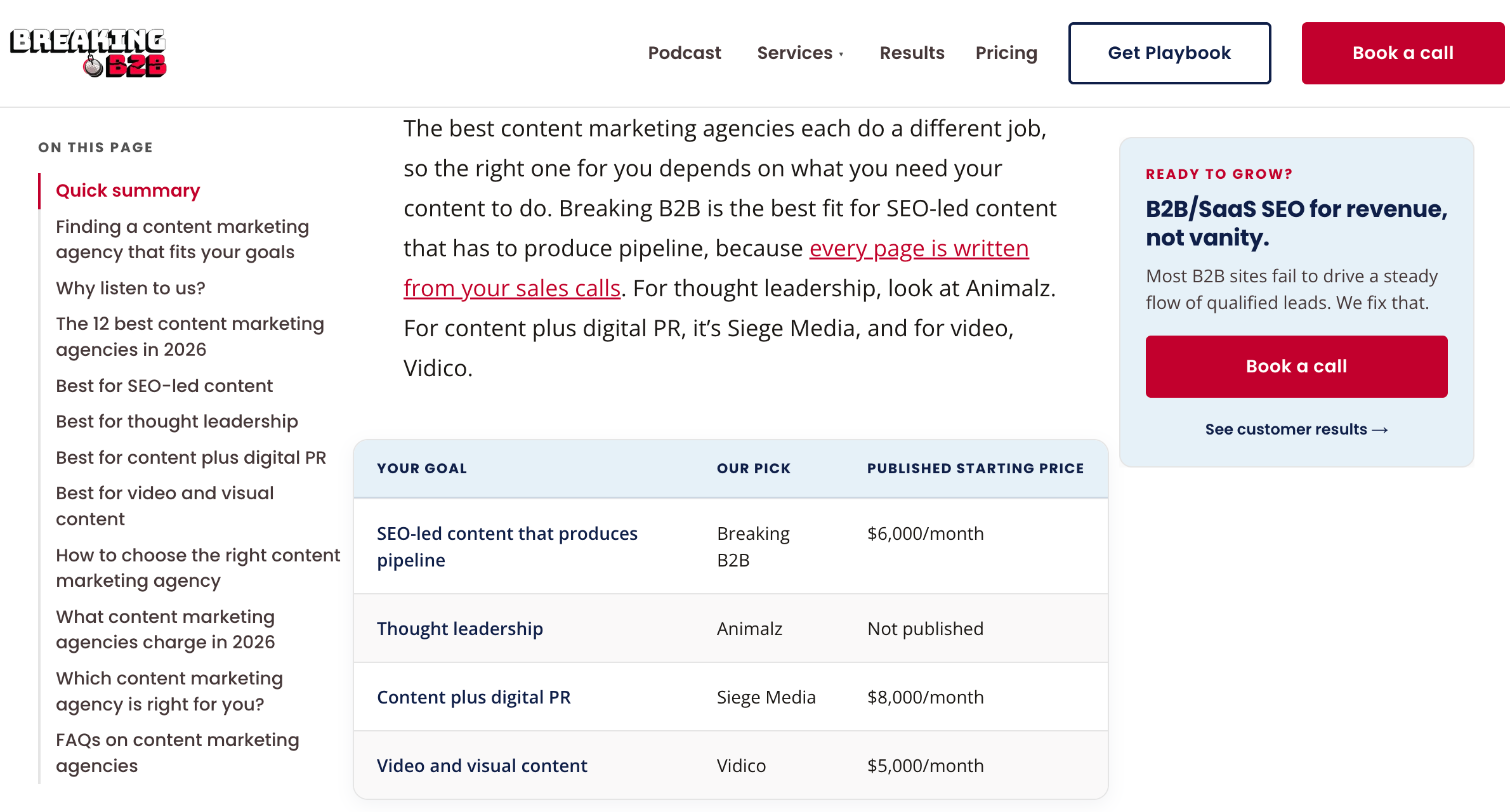
Green Flag Digital hid nothing. It discloses its interest and also publishes a separate scored ranking that puts a competitor, Siege Media, in first place. The trouble is the answer itself: Google and ChatGPT turn an agency's own roundup into what reads like a neutral recommendation, and the warning at the top of the page gets lost along the way. The only reliable check is to open the sources, and if you sell a service, it pays to know which roundups in your niche the assistants rely on.
---
GEO and SEO: what's the same and what's different
Optimizing for AI answers goes by many names: GEO, AEO, LLMO, AIO. I call it NEO, for neural engine optimization. In substance it's almost the same as SEO, but AI answers are harder to verify and less predictable. Here's the case for that view and the case against it.
What they have in common
Google's official guide says optimizing for generative AI search is optimizing for the search experience, "and thus still SEO." Google's Danny Sullivan put it more simply at WordCamp US in 2025: good SEO is good GEO. Yandex's documentation says the same about Alice, which relies on sources that rank high in search.
Where they differ
My own estimate is that GEO is about 80% SEO. The rest is brand mentions away from your own site, answers that make sense without the surrounding text, and a different way of measuring success: instead of rankings, you count the share of answers that name you. ChatGPT strays furthest from regular search, as the second myth below shows. Mike King, founder of the agency iPullRank, rejects the "GEO = SEO" formula: "So no, this is not just SEO. It's what comes after SEO" (iPullRank). His argument is that AI search splits a question into dozens of hidden sub-queries and pulls individual passages out of pages.
Why the results are worse
Independent tests keep finding the same weak spots in AI search.
- Columbia University's Tow Center gave eight AI search engines 1,600 tasks: identify the source of a news excerpt. [More than 60% of the answers were wrong](https://www.cjr.org/tow_center/we-compared-eight-ai-search-engines-theyre-all-bad-at-citing-news.php); ChatGPT Search got 134 of 200 wrong.
- The European Broadcasting Union and the BBC checked more than 3,000 answers in 14 languages. [45% had at least one significant issue](https://www.ebu.ch/news/2025/10/ai-s-systemic-distortion-of-news-is-consistent-across-languages-and-territories-international-study-by-public-service-broadcaste), and 31% had problems with sourcing.
- Researchers at Washington University in St. Louis examined 98,000 claims from Google's AI Overviews and found that [11% weren't supported by the pages](https://arxiv.org/abs/2605.14021) the summary linked to. In an analysis the startup Oumi ran for [The New York Times](https://www.thestar.com.my/tech/tech-news/2026/04/08/how-accurate-are-googles-ai-overviews), even correct answers came with links that didn't back them up 56% of the time.
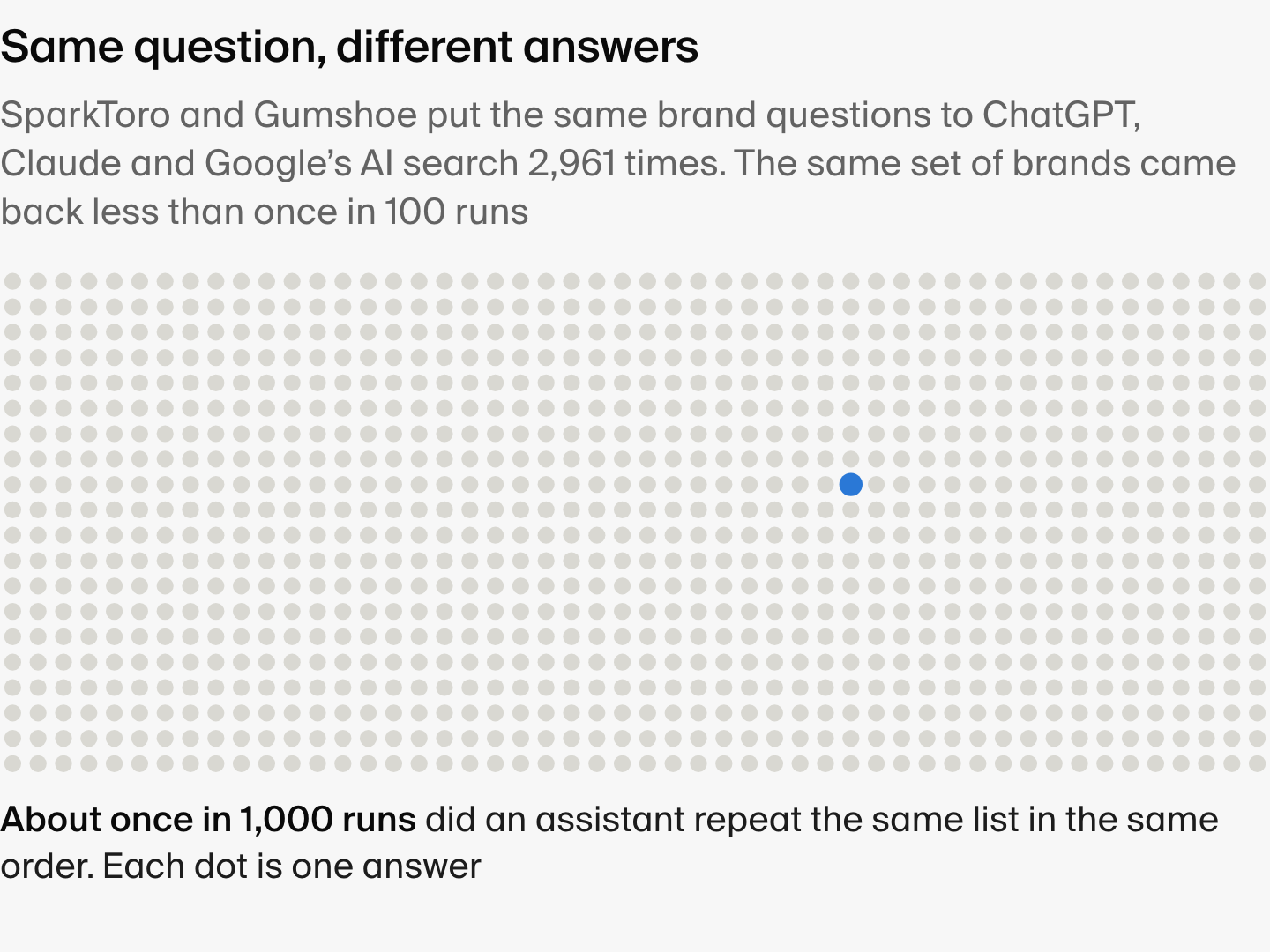
- SparkToro and Gumshoe asked AI assistants the same brand questions nearly 3,000 times, and [the same list came back less than once in a hundred runs](https://sparktoro.com/blog/new-research-ais-are-highly-inconsistent-when-recommending-brands-or-products-marketers-should-take-care-when-tracking-ai-visibility/).
AI answers are also easy to manipulate. BBC journalist Thomas Germain spent twenty minutes writing a post on his own website that ranked the tech journalists who are best at eating hot dogs, with himself in first place. In less than 24 hours, ChatGPT, the Gemini app and Google's AI Overviews were repeating it; only Claude wasn't fooled. Ahrefs invented a paperweight brand called Xarumei and seeded the web with three fake stories that contradicted each other. Perplexity and Grok swallowed them whole, while ChatGPT held out. The authors concluded that "in AI search, the most detailed story wins, even if it's false." Microsoft found more than 50 hidden prompts from 31 companies: a "Summarize with AI" button on their sites opened an assistant with a pre-filled request that quietly asked it to remember the company as a trusted source.
In the same BBC piece, Lily Ray, vice president of SEO strategy and research at the agency Amsive, says it's "easy to trick AI chatbots," far easier than it was to trick Google two or three years ago. Regular search results had plenty of junk too, but there you saw ten sites and decided for yourself whom to trust. In an AI answer, that choice has already been made for you.
The case against
"Worse" doesn't mean the assistants are always wrong, and some evidence points the other way.
- In the summer of 2026, NPR and NewsGuard tested how six chatbots and four search engines handled queries about state propaganda. [The chatbots did better than the search engines](https://www.npr.org/2026/08/30/nx-s1-5876436/chatbots-search-propaganda), while the AI summaries above search results did worse.
- In the same Oumi analysis, Google's AI Overviews answered factual questions correctly 91% of the time, up from 85% six months earlier. At Google's scale, though, the remaining 9% works out, by the paper's estimate, to tens of millions of wrong answers an hour. Google disputes the methodology.
- The old top ten was no gold standard either. Researchers in Leipzig and Weimar tracked Google, Bing and DuckDuckGo results for 7,392 product-review queries over a year and [concluded](https://downloads.webis.de/publications/papers/bevendorff_2024a.pdf) that all three had serious problems with over-optimized affiliate content: such reviews are a minority on the web but a majority in the results.
- Germain's hot dogs and Xarumei worked because nobody else had written about either. Google calls these "data voids," and a spokesperson says the company is working to keep AI Overviews from appearing for them. On a topic lots of people write about, a single post is unlikely to change the answer.
- People find these answers useful: in a [Pew survey](https://www.pewresearch.org/chart/a-majority-of-americans-say-they-read-ai-summaries-at-the-top-of-search-results/), 60% of Americans said they read the AI summaries at the top of search results. And the reasoning modes give noticeably better answers; in my own test, ChatGPT Pro went to primary sources.
So the bottom line is this: an AI answer is more often right than wrong, but it's harder to check and easier to fake than the old results page. That's what I mean by "worse." Optimizing for AI is still worth doing, especially since it takes almost no separate work: nearly everything an AI assistant needs from your site, search engines and readers need too.
---
10 GEO myths
A whole market of advice and services has grown up around GEO. Here are the ten most common claims and what's actually known about them.
"SEO is dead; now you need GEO"
The job hasn't changed, only the name. Ahrefs' Ryan Law said as much: "So for now, GEO, LLMO, AEO… it's all just SEO." Google's John Mueller was blunter: the more urgency and new acronyms someone pushes, "the more likely they're just making spam and scamming." GEO has its differences, described above, but it rests on the same foundation as SEO.
"If my site ranks at the top, it'll be in the answer"
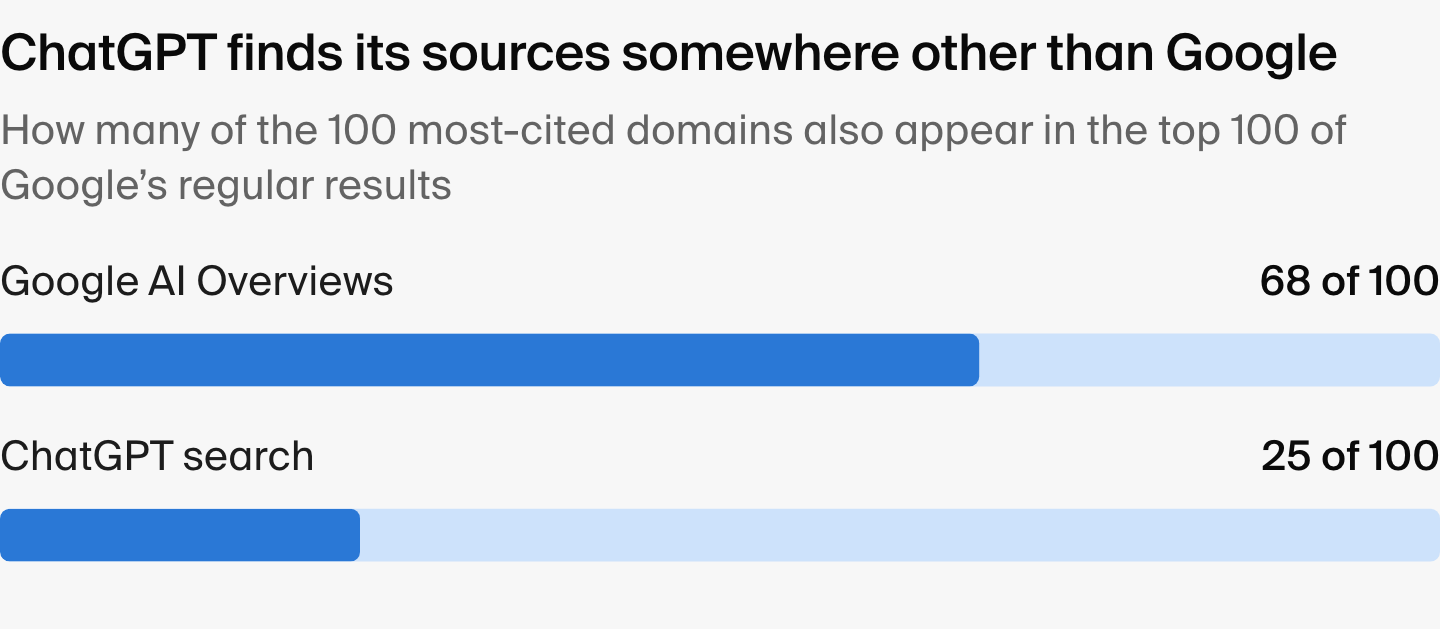
That's partly true for Google, where the link between rankings and AI answers is strong: among the 100 most-cited sites, its AI Overviews and its regular results overlap by 68%. Ranking alone isn't enough, though, and for ChatGPT the link is much weaker: its most-cited sites overlap with Google's regular results by only 25%.
"You need an llms.txt file"
An llms.txt is a text file placed at the root of a site that describes it for language models. Google ignores it, so the file neither hurts nor helps. Google's John Mueller wrote back in 2025: "FWIW no AI system currently uses llms.txt" (Bluesky). In June 2026 Ahrefs went through the logs of 137,000 sites and found that 97% of these files got no requests at all in a month. Their verdict: "No bots. No humans. Nothing." The file may be of some use to AI agents that read software documentation.
"AI needs special markup"
Google says there is no special schema.org markup for AI search. Ahrefs tested this on 1,885 pages that added markup. They weren't cited more often in ChatGPT or AI Mode, and in Google's AI Overviews they ended up with 4.6% fewer citations than pages without markup. In the study's words, "Adding schema produced no major uplift in citations on any platform" (Ahrefs). Markup is useful for something else: it helps a search engine understand who wrote a page and which organization stands behind a site.
"Write for the robots: chop text into chunks and stuff it with keywords"
Google specifically says there's no need to break text into chunks or write it "for AI." In a Princeton-led experiment, keyword stuffing lowered a source's visibility in the answer by 8–10%. A clear structure does help, but that's ordinary good layout, covered in step 6 of the checklist.
"To keep your text out of training, block every AI crawler"
This advice backfires, because OpenAI and Anthropic use different crawlers for model training and for search. Block the search crawler and your site disappears from the answers: OpenAI says such sites will show up in ChatGPT search answers at most as a navigational link. Block only the training crawlers and keep the search ones open; step 1 of the checklist explains how.
"Publish a 'best X' list with yourself at number one, and AI will start recommending you"
For a while that worked, but it has become risky. In 2025 such lists were the most common source ChatGPT drew on for "which one should I pick" questions. From January 2026, however, sites with hundreds of self-promotional listicles lost 29% to 49% of their Google visibility (Lily Ray, who spotted the trend, notes that such drops can have many causes). By September, Google's AI Overviews were citing such lists 38% less often. Worse, in 83% of cases the publisher itself didn't make it into the AI recommendation, and in 70% its list helped competitors get there instead. My own test showed both outcomes at once: Google put Green Flag Digital into its answer, while ChatGPT cited Breaking B2B's list and left Breaking B2B out. Ray's warning is that what works today can quietly become a liability tomorrow.
"Reddit, YouTube and Wikipedia decide everything"
That's partly true: brand mentions on YouTube correlate with AI visibility more strongly than anything else, at 0.74, compared with 0.2 for backlinks (Ahrefs, 75,000 brands). But the authors themselves caution that correlation isn't causation, since strong brands simply get talked about more. The picture is also shifting quickly. Between January and August 2026, ChatGPT cut its citations of social networks and forums by 44%, so betting everything on a single platform is risky.
"We're number three in ChatGPT"
There's no such thing as a ranking in an AI answer. In SparkToro and Gumshoe's test, the same list of brands came up less than once in a hundred runs, and the same list in the same order about once in a thousand. "AIs do not give consistent lists of brand or product recommendations," writes SparkToro's founder, Rand Fishkin. The only meaningful measure is the share of answers that name you across dozens of runs. Nobody can guarantee a place in the answer either: OpenAI states plainly that placement in ChatGPT search isn't guaranteed, and Google says that inflating mentions is less useful than it looks. In May 2026 Google also clarified that its spam policies apply to AI answers. The only thing you can buy is advertising next to the answer.
"AI will replace Google as a source of visitors"
That isn't happening yet. As of early 2026, Google was sending 190 times more people to websites than ChatGPT, and chatbots account for less than 1% of publishers' traffic. In one week, ChatGPT, Perplexity and Gemini sent not a single visitor to my site AIGENCY; more on that in the teardown below.
---
What to do on your site: a 10-step checklist
The steps are listed in order of importance, and each one helps with both search engines and AI assistants.
Step 1. Let the AI search crawlers in
Three kinds of AI crawlers visit websites, and each calls for a different approach.
| Kind | Why it comes | Who | If you block it |
|---|---|---|---|
| Search | Builds the index answers are drawn from | OAI-SearchBot, Claude-SearchBot, PerplexityBot, Googlebot, Bingbot, YandexBot | You disappear from the answers |
| Training | Collects text for future models | GPTBot, ClaudeBot, Meta-ExternalAgent, CCBot | Models will know less about you. For OpenAI and Anthropic, search isn't affected |
| User-triggered | Opens a page when someone asks about it in a chat | ChatGPT-User, Claude-User, Perplexity-User | Some of these don't follow robots.txt |
Here's a robots.txt that allows search and blocks training:
```
# Search and answers with links: allow
User-agent: OAI-SearchBot
User-agent: Claude-SearchBot
User-agent: PerplexityBot
Allow: /
# Model training: block
User-agent: GPTBot
User-agent: ClaudeBot
User-agent: CCBot
Disallow: /
# Shared no-training token: Anthropic honors it since 2026-10-30,
# Microsoft from 2027-02-01, Google in 2027, OpenAI "in the coming months".
# Google will read it as disallowing Google-Extended, which also drops your links in Gemini app answers
User-agent: __usage_ai-training
Disallow: /
Sitemap: https://example.com/sitemap.xml
```
Whether to block training is up to you. My sites are open to every crawler, because for a publication being known matters more. Google plays by its own rules: the same Googlebot collects pages for search and for AI summaries, and you can take your site out of AI answers while staying in regular results through a Search Console setting. On Yandex, a `YandexAdditional` line in robots.txt does the same.
It's also worth checking your hosting. OpenAI specifically asks site owners to make sure their host or CDN lets its search crawler through. On Cloudflare, AI crawlers were blocked by default on new domains from July 2025, and since September 2026 they've been split into search, agent and training crawlers. To keep out training only, choose Disallow AI Training in Cloudflare's settings. The Block option now also stops Googlebot and Bingbot, which takes you out of regular search as well.
Step 2. Make sure crawlers can see your text
This is a common and costly mistake on sites built with React or Vue or with builders like Lovable. A person sees the whole page, while a crawler gets an empty shell, because the text only appears after JavaScript runs. Google can execute scripts, but most other crawlers can't. A late-2024 study by Vercel and MERJ found that "none of the major AI crawlers currently render JavaScript," apart from Google's and Apple's.
The check takes a minute:
```bash
URL="https://example.com/your-article"
UA="Mozilla/5.0 (Macintosh; Intel Mac OS X 10_15_7) AppleWebKit/537.36 (KHTML, like Gecko) Chrome/131.0.0.0 Safari/537.36; compatible; OAI-SearchBot/1.4; +https://openai.com/searchbot"
curl -sL -A "$UA" "$URL" -o bot.html -w "%{http_code}\n"
python3 -c "import re,html;t=open('bot.html',encoding='utf-8').read();t=re.sub(r'(?s)<(script|style).*?</\1>','',t);print(len(html.unescape(re.sub(r'<[^>]+>',' ',t)).split()),'words')"
```
If the word count is close to zero, the site needs prerendering, meaning its pages are built into finished HTML in advance or on the server. I describe how I did that in the build-a-site-in-a-day guide and the FailForward case study.
Step 3. Get into the indexes
AI answers come from search indexes, so your site needs the free webmaster consoles: Google Search Console, Bing Webmaster Tools and, for a Russian-speaking audience, Yandex Webmaster. Bing matters because Copilot and, in part, ChatGPT run on its search. Submit your sitemap in each console and check a few days later that it has actually been read.
New pages are easiest to submit through IndexNow: one submission is shared with Bing, Yandex and the other participants. Google doesn't support the protocol, and a sitemap is enough for it.
```bash
curl -X POST "https://api.indexnow.org/indexnow" \
-H "Content-Type: application/json" \
-d '{"host":"example.com","key":"YOUR_KEY","keyLocation":"https://example.com/YOUR_KEY.txt","urlList":["https://example.com/new-page"]}'
```
Step 4. Clean up your URLs
A URL that doesn't exist should return a 404, a page that has moved should redirect with a 301, and language versions should carry hreflang tags. Otherwise search engines file empty copies of your homepage as duplicates and are slower to index the rest.
This is easy to check: request a made-up address with `curl -sI https://example.com/qwerty123 | head -1`. If the server answers with a 200 instead of a 404, it needs fixing.
Step 5. Name the page the way people will ask about it
An assistant searches with its own queries and is more likely to cite pages whose titles resemble them. So the `<title>` tag should carry the name, the product or the topic, with no riddles. A title like "Elon Musk in 2008: how SpaceX survived three failed launches" works better than "Why he didn't give up." Google and Yandex set no hard length limit; long titles simply get cut to fit the screen, so put the key words first. In practice, titles usually stay under 60 characters and descriptions within 120–160.
Step 6. Answer right away
Under every heading, give the answer in a sentence or two first and save the detail for later. Headings work well when they're phrased the way people ask, such as "How much does…" or "What's the difference between…". Comparisons are best shown in tables and steps in lists, and the last-updated date, the author's name and the sources should be easy to find.
That's ordinary good layout, but it matters even more for AI. "AI assistants don't read a page top to bottom like a person would," explains Krishna Madhavan of Microsoft Bing. They break a page into pieces and build the answer from the best ones. So headings, lists, tables and question-and-answer pairs help, while an answer tucked away in a tab, a PDF or an image can get lost.
Step 7. Add something no one else has
Google advises publishing what comes from your own experience and goes beyond common knowledge. In the Princeton-led experiment, a source became most visible when quotes, statistics and cited sources were added to the text: by 30–40%, and by up to 115% for a site ranked fifth. For the site already ranked first, the same techniques actually reduced visibility, so they mostly help those who aren't on top yet. The experiment ran on a 2023-era engine, though, and today's are more complex.
In practice that can mean your own numbers, tested experience, an expert quote with a link, or a reconciliation of sources that disagree.
Step 8. Build your "about" page
An assistant answers questions about a company from the company's own site. So you need an About page with a clear description, an author with a name and a bio, contact details and a way to report mistakes. Your name, brand and job title should match everywhere: on the site, on LinkedIn and on YouTube.
Minimal markup helps a search engine tie all of this together:
```html
<script type="application/ld+json">
{
"@context": "https://schema.org",
"@type": "Article",
"headline": "Short article headline",
"datePublished": "2026-11-23",
"dateModified": "2026-11-23",
"author": { "@type": "Person", "name": "First Last", "url": "https://example.com/about" },
"publisher": { "@type": "Organization", "name": "Publication name", "logo": "https://example.com/logo.png" }
}
</script>
```
Step 9. Get into the roundups and rankings in your niche
Ask the assistants the questions your customers ask, such as "which service should I choose" or "best agencies for…". See which roundups and rankings they cite and earn a place in them. That's more reliable than writing a roundup with yourself at number one, and the seventh myth explains why. Beyond roundups, what works is giving talks and interviews and taking part in professional communities under your own name.
Step 10. Measure once a month
| What | Where to look |
|---|---|
| Impressions in Google's AI summaries and AI Mode | Search Console → Performance → Generative AI (more here) |
| Citations in Copilot and Bing's AI summaries | Bing Webmaster Tools → AI Performance |
| Share of Alice AI answers that cite you | Yandex Webmaster, the Alice AI visibility report |
| Visits from ChatGPT, Gemini, Perplexity | GA4, the AI Assistant channel (clicks from Google's AI summaries don't land there) |
| What the assistants actually say | 10–20 of your customers' questions once a month, logged out, so that memory doesn't tailor the answers to you |
These numbers come with three caveats. Search Console mixes clicks from AI summaries in with regular clicks, so you can't see them separately. Because answers vary so much, look at your share across many tries rather than at one lucky screenshot. And tell a citation from a mention: in Semrush's data, 62% of the time a site showed up in an AI answer, it appeared only as a link, and the brand was never named in the text of the answer.
---
Tools: how to check whether AI can see you
The free tools in the table below are enough for most sites.
| Free | What you get |
|---|---|
| Google Search Console | Index, errors, clicks, impressions in AI summaries and AI Mode |
| Bing Webmaster Tools | Bing index, citations in Copilot, queries where competitors get cited |
| Yandex Webmaster | Yandex index, visibility in Alice AI |
| GA4 | Visits from AI assistants |
| Cloudflare AI Crawl Control | Which AI crawlers visit (the last 24 hours on the free plan) |
| PageSpeed Insights, Rich Results Test | Speed and markup |
| `curl` | What a crawler gets (step 2) |
Paid trackers ask the assistants your questions every day and count how often you and your competitors get named. They're worth paying for once the free tools aren't enough. Prices are as of November 2026; I checked the pages from Spain, and some services set the currency by country.
| Service | From | Worth knowing |
|---|---|---|
| Otterly.AI | €29/mo | Cheapest way in |
| Peec AI | $95/mo | Tracks prompts in any language |
| Semrush AI Visibility Toolkit | $99/mo | Convenient if you already use Semrush |
| Ahrefs Brand Radar | from $50/mo | $50 covers your own prompts; the 588M-prompt database starts at $199 |
None of these covers Yandex's Alice AI. For that there's the free Webmaster report and Russian services such as Topvisor.
You can also do a lot yourself. Nearly everything in the teardown I did with Claude Code: it crawled 926 URLs as Googlebot and as ChatGPT's crawler, compared the results before and after the fixes, and wrote checks I can rerun. If you have your site's repository, start with this request: "Check what search and AI crawlers see on every page, and list the problems."
---
Teardown of my sites: what I found and fixed
I tested everything above on two of my own sites. Both looked fine, and both were serving crawlers something different from what people saw.
FailForward
FailForward is a publication about the failures of well-known founders, with 30 stories in English and Russian. It's built with React, and until November 22 its text existed only in the browser.
| | Before | After |
|---|---|---|
| What an AI crawler received | An empty `<div id="root">` | 1,800–5,600 characters of text on every page |
| Sitemap in Google | "Couldn't fetch" since August 28; Google never read it | Resubmitted; Google's live test says "URL is available to Google" |
| Titles | 32 of 54 over 60 characters, without the founder's name | Name first, 60 characters at most |
| Two stories' descriptions | Broken: "$170" turned into "$1" during a string replace in the code | Fixed |
| A URL that doesn't exist | The homepage, with a 200 | A 404 page: "This Page Failed to Launch" |
For three months the site looked fine, and none of these problems was visible to the eye. I only found them when I looked at the site the way a crawler does.
AIGENCY
AIGENCY is a media project about AI with around 460 pieces in two languages. An agent keeps it filled: several times a day it picks up posts from my Telegram channel, translates them and publishes them.
| | Before | After |
|---|---|---|
| Words ChatGPT's search crawler got from an article | 0 | The full text |
| `<title>` over 60 characters | 389 pages | 0 |
| Description over 160 characters | 405 pages | 0 |
| A URL that doesn't exist | A copy of the homepage, with a 200 | 404 |
| First screen on a phone over slow 4G | 7.2 s | 3.0 s |
The most interesting find was in Search Console. Google had flagged 30 URLs as duplicates, among them `/ru/news/Z.ai` and `/ru/news/PROMPT.md`: the crawler had taken names in the text for links, and the site answered with a copy of the homepage. Another 482 pages had been crawled but not indexed. Almost all of them were short news posts repeating what was already in my own Telegram channel. A thin copy of text that already lives somewhere else is of no use to a search engine or an AI assistant.
What it got me
What you can check the same day changed right away: crawlers get the text, and the console errors are fixed. Changes in the index and in AI answers will take a few weeks to show, so here's the "before" snapshot from November 23. I'll repeat it in a month and add the result here.
| | AIGENCY | FailForward |
|---|---|---|
| Google clicks, last 3 months | 77 | 8 |
| Google impressions, last 3 months | 9,700 | 980 |
| Impressions in AI summaries and AI Mode | 457 across 53 pages | 111 across 16 pages |
| Pages in Yandex search | 473 of 483 | 53 of 54 |
| Visibility in Alice AI | Not enough data | Not enough data |
| Visits from chatbots in a week | 0 | No logs |
| Answers on the site's topics that link to it | 0 of 12 | 0 of 15 |
The snapshot shows that Google's AI answers pick up short, specific pieces. On AIGENCY, the most AI impressions went to a guide on moving chats between assistants, a news item about Qwen Chat's rename, and the price of Claude Max in the App Store.
AI crawlers read the site more often than Google does, but they don't send people. In one week, verified OpenAI crawlers hit AIGENCY about 470 times and Googlebot about 80 times. Not a single visit came from a chatbot in that time.
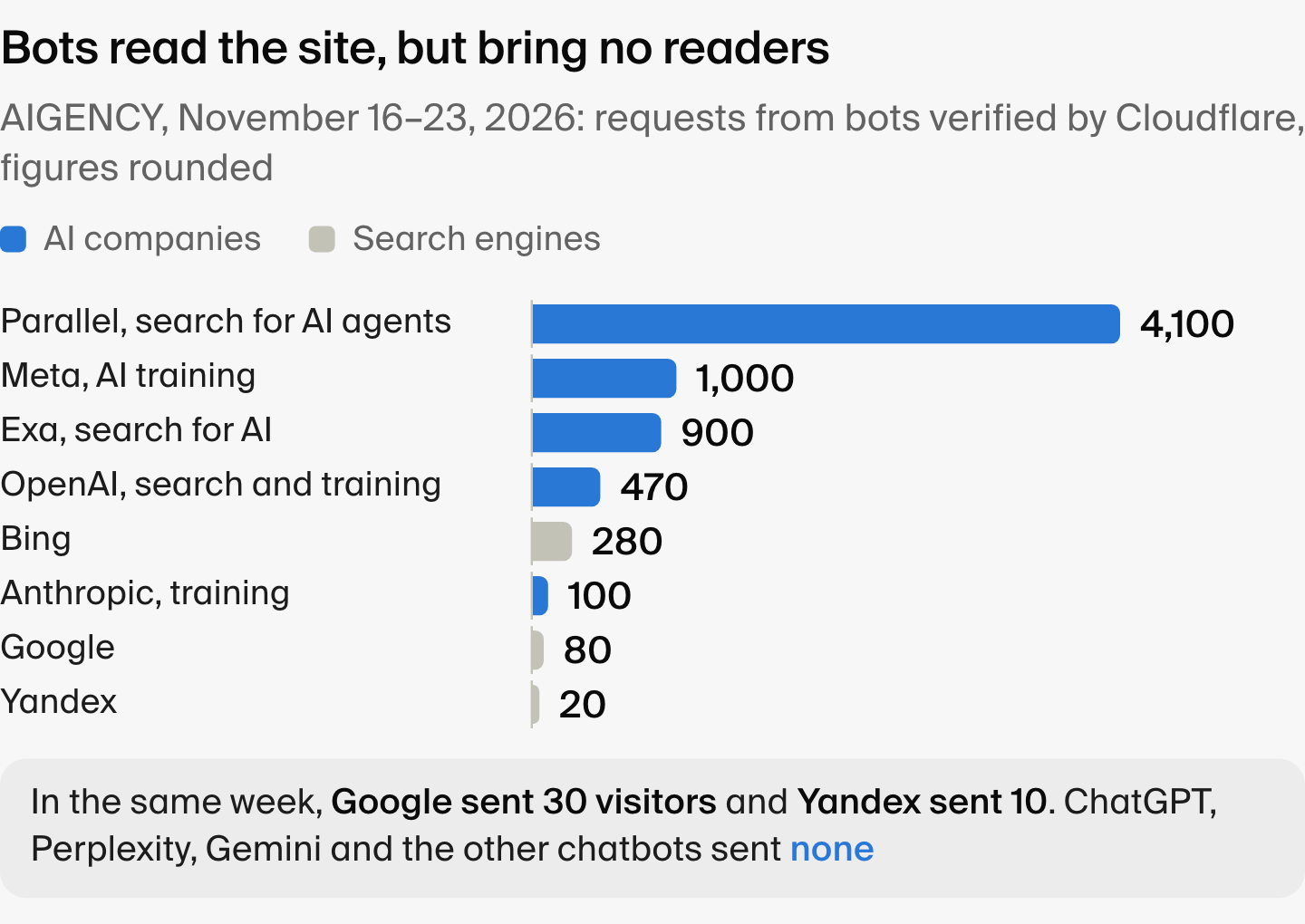
Don't trust the crawler names in your logs, though. Of 5,500 requests signed "Googlebot," Cloudflare verified about 80; the rest turned out to be my own audits and other people's scanners.
---
8 common mistakes
1. A JavaScript app runs without prerendering, so crawlers see an empty page.
2. URLs that don't exist return a 200 and a copy of the homepage, the so-called soft 404s.
3. The hosting provider blocks AI crawlers, and the site owner doesn't know it.
4. The sitemap was submitted, but nobody checked whether the search engine read it.
5. The page title is missing the key word.
6. The site is full of thin copies of posts from its own Telegram channel or social media.
7. People and crawlers get different text: some of my English pages served crawlers the Russian text.
8. The owner believes in a magic button. llms.txt, FAQ markup and "AI optimization in a week" won't replace text that crawlers can read or real expertise.
---
FAQ
Are GEO, AEO, LLMO, AIO and NEO the same thing?
Yes, they're different names for the same job: getting into an AI's answer. Google considers it part of SEO.
How do I know if ChatGPT cites me?
Look for visits from chatgpt.com in your analytics, and once a month ask ChatGPT your customers' questions, several times each. It's best to do this logged out, because even a temporary chat uses memory by default and tailors the answer to you. If you run an online store or an online service, set up Business Hub: it shows mentions and clicks for the past 28 days.
Should I block GPTBot and other training crawlers?
That's a question about the rights to your content, and it doesn't affect your visibility in search. OpenAI and Anthropic keep search and training separate, so blocking GPTBot and ClaudeBot keeps you in their search. Google is different: blocking Google-Extended also removes links to you in the Gemini app.
Can I keep my site out of Google's AI summaries but stay in search?
Yes. Since August 31, 2026, you can do it in Search Console under Settings → Search generative AI (help page). Google says it doesn't affect your rankings in regular results.
How long until I see results?
Search engines pick up technical fixes within days or weeks. Validation in Search Console typically takes up to about two weeks, sometimes longer. Content and mentions take months to pay off.
Does this work for Yandex and Alice?
Yes. Yandex says Alice AI relies on sources that rank high in its search and selects them for expertise, usefulness, originality and substance. So a good ranking in regular Yandex search comes first.
Can I buy a spot in an AI answer?
You can't buy a place in the answer itself, and it's wise to be suspicious of anyone promising to "get you into ChatGPT in a week." What you can buy is advertising: Google already shows ads in AI Mode in the US and ten other countries, though not in the EU.
---
Read next
- [A whole media site in one evening: how Claude Code built FailForward](/en/news/failforward-case)
- [How I built a website in one day using AI](/en/guides/site-with-ai)
- [Author blogs vs AI slop](/en/news/author-blogs-vs-ai-slop)
- [Media lost half their search traffic to AI while chatbots deliver less than 1%](/en/news/media-search-traffic-ai-chatbots-1pct)
- [Google rebuilds search for the first time in 25 years — sites and ads are next](/en/news/google-search-ai-overhaul-io2026)
- [Bots and AI agents overtook humans in web traffic — 57.4% versus 42.6%](/en/news/cloudflare-ai-bot-traffic-surpasses-human)
---
AI hasn't killed search: it retells what it finds in the search index. To make it into that retelling, a site needs the same things as before. Crawlers have to be able to read the text, the site has to be in the indexes, and the text has to contain something of your own. If you don't know where to start, start with step 2 and look at your site the way a crawler does.